
Joseph Henner

My AI Training



Lander Free Medical Clinic
Organization Facts
Lander Free Medical Clinic provides free healthcare and wraparound services to low-income, uninsured, and underinsured residents of Fremont County, Wyoming.
The clinic offers primary care, prescription assistance, diagnostic testing, specialty referrals, and access to dental and vision services.
Its services help eliminate financial and insurance barriers that can prevent individuals from receiving necessary medical treatment.
By combining direct healthcare with connections to community resources, the clinic promotes preventative care, continuity of treatment, and improved long-term health outcomes.

Lander Free Medical Clinic
About the Organization
Lander Free Medical Clinic works to create more equitable access to healthcare for individuals who may otherwise delay or forgo medical treatment because of cost.
Its patient-centered approach addresses both immediate medical concerns and broader factors that influence health and well-being.
The clinic connects patients with specialty care, medications, diagnostic services, and resources related to transportation, food, housing, dental care, and other needs.
Through these services, the organization strengthens the healthcare safety net in Fremont County and helps vulnerable residents receive care with dignity.

Lander Free Medical Clinic
Community Involvement
Lander Free Medical Clinic is supported by volunteer physicians, nurses, healthcare professionals, community volunteers, and other individuals who contribute their expertise and time.
The clinic collaborates with local healthcare providers to facilitate specialty referrals, diagnostic services, and additional forms of patient care.
Community relationships, including work with First Stop Help Center, help patients access additional resources such as transportation assistance and essential supplies.
Support from organizations such as the LOR Foundation and Lander Community Foundation has also helped the clinic expand services and address barriers affecting patient health.

Lander Free Medical Clinic
Funding Source
Lander Free Medical Clinic is supported primarily through individual donations, charitable contributions, foundation grants, and community philanthropy.
The organization accepts direct financial donations as well as securities and qualified charitable distributions to help sustain its free services.
Grant support, including funding from the LOR Foundation and other community foundations, has helped expand dental, vision, specialty care, and wraparound assistance.
These resources allow the clinic to provide medications, testing, referrals, medical services, and other forms of assistance without transferring the cost to eligible patients.

My AI Proposal
Throughout the AI & Medical Innovation Internship, I worked closely with Lander Free Medical Clinic to understand its operating model, goals, current patient intake system, and growth opportunities. Alongside Dr. Daniel Spar and Dr. Omar Aljawfi, I learned the fundamentals of artificial intelligence and explored how emerging AI technologies can be strategically applied to address real-world medical operational challenges, including patient intake, community awareness campaigns, patient-interface systems, and more.
Throughout the week, my team approached Lander Free Medical Clinic as business consultants, analyzing its existing processes, identifying operational vulnerabilities, and evaluating areas where artificial intelligence could create meaningful value. We considered the organization’s specific needs and researched potential AI applications that could improve efficiency, strengthen operations, support patients, and contribute to long-term growth.
Using our research and analysis, my team developed a comprehensive AI business proposal tailored specifically to Lander Free Medical Clinic. Our recommendations outlined practical strategies for integrating artificial intelligence into the organization while considering implementation, potential risks, and ethical and legal frameworks. The final proposal, shown alongside this description, represents the culmination of our week-long consulting process and demonstrates how AI can be applied strategically to solve real medical challenges.

My AI Proposal Presentation
During the AI & Medical Innovation Internship, I worked with Dr. Daniel Spar and Dr. Omar Aljawfi to learn about the basics of artificial intelligence and the potential medical applications it possesses.
Throughout the week, I worked with a clinic named Lander Free Medical Clinic to develop AI solutions to support their operations and healthcare offerings. I worked with my team to analyze the opportunities for growth as well as their current vulnerabilities.
At the end of the week, I presented my AI proposal to a panel of judges and the LI Grant Committee, and I received grant money to implement the solution to support the clinic, their healthcare services, and the broader health of their community.
Internship Highlights
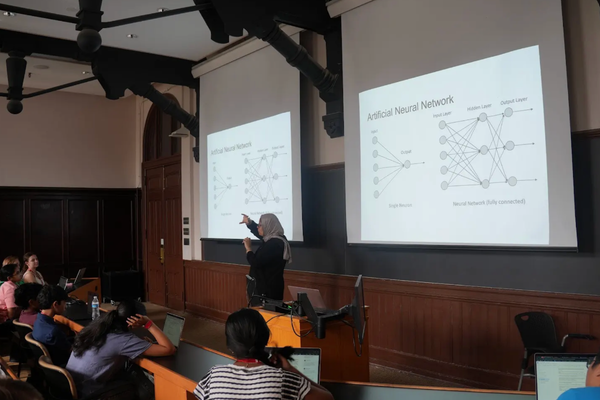
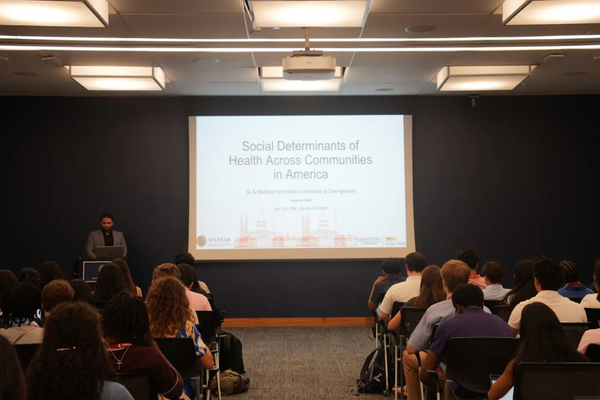
Throughout my internship, I participated in multiple hands-on labs that allowed me to utilize technology and artificial intelligence to create solutions for optimization in various healthcare settings.
These labs were created to replicate real-world scenarios and enabled me to develop applicable solutions to complex problems. This immersive experience allowed me to develop proficiencies in programming languages, implementing CNNs for image classification in the context of diagnostics, and the use of predictive analytics in healthcare.
Each session required attention to detail and the utilization of my skills in collaboration, critical thinking, and adaptability to learn in a fast-paced setting. This was an invaluable experience that allowed me to translate theoretical knowledge into tangible solutions.
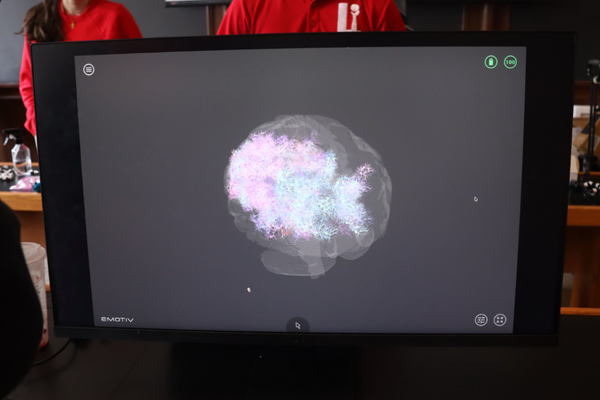
Virtual and augmented reality have transformed healthcare delivery, allowing medical professionals and students to learn and perform select diagnostic and therapeutic procedures in a remote setting.
During this internship, I had the opportunity to learn about the uses of virtual reality in medicine. I also participated in hands-on activities that allowed me to learn about the applications of virtual reality in surgery and radiation oncology planning.
Many people live in areas where access to quality care of specialty services is limited. Virtual reality and technology have been instrumental in bridging this gap. These activities helped broaden our understanding of this complex issue, and this new knowledge will be applied to the solutions we develop for our clinical partners.
During my internship, I gained valuable insight into the world of robotics from Dr. Laura Stegner, a distinguished professor in the Department of Mechanical and Aerospace Engineering at The George Washington University. She introduced the concepts behind a wide range of technology that facilitates the delivery of more precise, efficient, and minimally invasive patient care.
Dr. Stegner, alongside lectures from MedStar faculty, including Dr. Omar Aljawfi, covered the growing potential of medical innovation and the increasing demand due to the aging patient population. Current applications include surgical robotics, rehabilitation and exoskeleton technology, automation in laboratory settings, and remote care robotics.
Additionally, we researched the logistical and regulatory challenges associated with implementing medical technology and innovation into day-to-day practice. These challenges include the high cost associated with the machinery and the specialized training required for operation.
Understanding the logistical, financial, and medical implications of this technology enabled me to strengthen my critical thinking and problem-solving skills, allowing us to apply this knowledge to our clinical partnership.

During my internship, I had the opportunity to apply my training in AI consulting by working directly with clinics around the United States. Meeting with Lander Free Medical Clinic allowed me to gain a clear understanding of their goals, challenges, and long-term vision, giving me the chance to explore how artificial intelligence could provide meaningful solutions.
Working alongside their leadership, I developed tailored recommendations on how AI tools could streamline operations, improve patient relations, and improve healthcare offerings. This included analyzing areas where automation could reduce inefficiencies, identifying opportunities for predictive analytics, and suggesting ways to incorporate AI-driven patient strategies.
Through this hands-on consulting experience, I not only strengthened my ability to assess patient and clinic needs and translate them into actionable strategies but also learned the importance of aligning AI solutions with each clinic’s unique context. By applying these skills, I was able to deliver practical recommendations that could support Lander Free Medical Clinic in reaching its goals and preparing for long-term success in an increasingly data-driven economy.